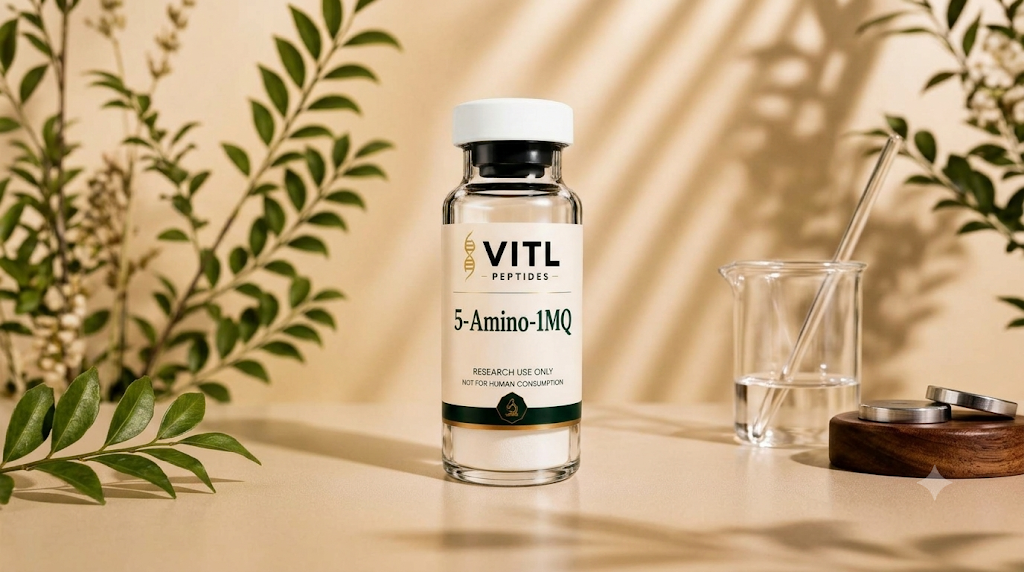
5-Amino-1MQ Research Compound: Scientific Background and Key Findings
Scientific interest in cellular metabolism has led researchers to examine enzymes that influence how cells process and use different compounds. One such enzyme is nicotinamide N-methyltransferase (NNMT), which is involved in nicotinamide metabolism and methylation-related processes. The 5-Amino-1MQ Research Compound is a small molecule being investigated for its ability to inhibit NNMT and influence related metabolic pathways. Early laboratory experiments and animal studies have reported changes in cellular metabolites, fat cell activity and body weight. These findings have created opportunities for further investigation, although human safety and clinical effects remain unestablished. Vitl Peptides supplies research-use-only materials with product specifications and batch documentation for qualified laboratory research.
5-Amino-1MQ is a small-molecule compound studied for its interaction with nicotinamide N-methyltransferase (NNMT). It is not a peptide, despite sometimes appearing alongside research peptides in laboratory product catalogues. mNNMT is an enzyme that helps convert nicotinamide into 1-methylnicotinamide (1-MNA). This reaction uses S-adenosylmethionine (SAM), a molecule that provides methyl groups for several biochemical processes. Researchers are interested in NNMT because its activity is connected with different metabolic pathways. These include:
● Nicotinamide processing and NAD+ metabolism.
● Cellular energy-related activity.
● Methylation and biochemical signalling.
● Metabolic processes within fat tissue.
By studying NNMT inhibition, scientists can investigate how changes in enzyme activity influence these interconnected processes.
How Does 5-Amino-1MQ Interact with NNMT?
The main research interest surrounding 5-Amino-1MQ relates to its ability to inhibit NNMT. Under normal conditions, NNMT helps convert nicotinamide into 1-MNA by transferring a methyl group from SAM. This process also produces S-adenosylhomocysteine (SAH). In laboratory models, inhibiting NNMT can reduce the production of 1-MNA. It may also influence the availability of nicotinamide and other compounds involved in cellular metabolism.
NAD+ is particularly relevant to this research. It is a coenzyme involved in energy production, cellular signalling and several enzyme-controlled reactions. Scientists are examining how NNMT inhibition may affect NAD+ levels and related metabolic activity. The exact response depends on the experimental model, compound concentration and study conditions. Laboratory observations should not be treated as evidence of the same effects in humans.
Five Important Findings from Published Research
A 2018 study published in Biochemical and Biophysical Research Communications investigated selective, membrane-permeable NNMT inhibitors, including 5-Amino-1MQ. Its findings provide much of the early scientific background for this compound.
1. Reduced NNMT Activity in Fat Cells
Researchers investigated how 5-Amino-1MQ affected NNMT activity in 3T3-L1 pre-adipocytes and differentiated adipocytes. The experiments showed a reduction in intracellular 1-MNA levels following treatment. This supported the compound’s ability to inhibit NNMT in the tested cellular models. The researchers also observed concentration-dependent changes in 1-MNA levels. These findings helped establish a measurable way to examine the compound’s activity during further experiments.
2. Changes in NAD+ and SAM Levels
Another finding involved changes in two important cellular metabolites: NAD+ and SAM. Researchers observed increased intracellular NAD+ levels following 5-Amino-1MQ treatment in differentiated adipocytes. Changes in SAM levels were also reported at certain tested concentrations.
These observations are relevant because NAD+ supports cellular energy-related processes, while SAM contributes to methylation reactions. The findings suggest that NNMT inhibition can influence more than one metabolic pathway. However, the results came from cell-based experiments and do not establish an increase in NAD+ or improved energy levels in humans.
3. Reduced Lipid Accumulation in Cell Models
The study also examined lipogenesis, which refers to the process through which cells produce and store fat. Experiments involving differentiating 3T3-L1 cells showed that 5-Amino-1MQ reduced lipid accumulation in a concentration-dependent manner.
The researchers reported reduced lipogenesis at the tested concentrations of the compound. This provided further information about the relationship between NNMT activity and fat cell development. These findings remain specific to the laboratory conditions used in the study. They do not establish that the compound causes fat loss in people.
4. Observations in High-Fat-Diet Mice
Animal research provided another area of interest. Researchers investigated the effects of NNMT inhibition in mice with diet-induced obesity. During an 11-day experiment, mice receiving 5-Amino-1MQ showed a reduction in body weight compared with the control group. The researchers also reported changes in white adipose tissue mass and adipocyte size.
These observations suggested that NNMT inhibition could influence metabolic activity in animal models. However, a short-term mouse experiment cannot establish weight-loss effects, appropriate exposure levels or safety in humans. Further studies are required before any clinical conclusions can be drawn.
Researchers also examined how 5-Amino-1MQ interacted with other enzymes involved in related biochemical processes. The compound showed selectivity towards NNMT in the tested experiments, with no meaningful inhibition observed against several related methyltransferases at the investigated concentrations.
Selectivity matters in biochemical research because it helps scientists understand whether an observed response is connected with the intended enzyme or other biological targets. mFurther investigation is still needed to establish its broader biological activity and potential limitations.
Factors to Consider When Selecting Research Materials
Reliable research depends on more than the compound being investigated. Material identity, analytical testing and batch documentation can all affect the quality of laboratory work.
Researchers evaluating a 5-Amino-1MQ Research Compound may consider the following points:
● Chemical identity: Check that the material matches the stated compound.
● Purity information: Review the reported purity and supporting analytical results.
● Certificate of Analysis: Match the COA with the specific batch or lot.
● Product specifications: Confirm the supplied form and quantity.
● Storage guidance: Follow the manufacturer’s documentation and institutional laboratory procedures.
For laboratories comparing a research peptide supplier USA, transparent product specifications and batch traceability are useful considerations. Although 5-Amino-1MQ is a small molecule rather than a peptide, the same attention to material verification applies. Vitl Peptides lists its 5-Amino-1MQ material as research-use-only, with a stated purity of 99%+ and batch-specific analytical documentation for applicable lots. Its product information also identifies the material as a lyophilised powder.
Current Limitations and Research Safety
Despite the findings reported in early studies, several questions remain unanswered. Most of the available research on 5-Amino-1MQ involves cell cultures and animal models. There is not sufficient human clinical evidence to establish its safety, effectiveness, appropriate dosage or long-term effects.
Researchers should also consider that experimental outcomes can vary depending on the cell type, concentration, exposure period and study design. Findings from one model may not apply to another. The compound is supplied for qualified laboratory research only. It is not intended for human or veterinary consumption, diagnosis, treatment or clinical use.
Vitl Peptides provides product specifications and applicable batch documentation to help qualified researchers assess material identity and analytical information before laboratory evaluation.
Future Areas of Scientific Investigation
Further research may help clarify how NNMT inhibition affects cellular metabolism, NAD+ pathways and fat tissue activity. Scientists may also investigate how these responses differ between experimental models and how other biochemical processes are involved. More detailed studies could provide a clearer understanding of the compound’s selectivity, biological activity and limitations. Human clinical research would also be necessary before any conclusions about its safety or potential therapeutic applications could be considered.
Contact Vitl Peptides for 5-Amino-1MQ product specifications, batch documentation and research material enquiries. Our team can assist qualified laboratory professionals with product information.